





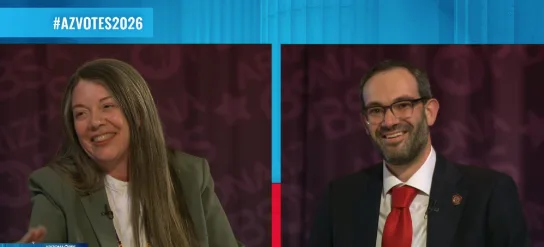
MOHAVE COUNTY — On Monday, May 18, four candidates in the race for Arizona’s 30th State House District debated a variety of issues in an online forum sponsored by the Arizona Clean Elections Commission. The forum was moderated by Arizona Agenda’s TJ L’Heureux and covered a range of issues facing the district, which includes Mohave and La Paz counties.
The candidates that participated were Kingman resident and rancher Mike Gannuscio, pastor and Lake Havasu School District board member David Rose, nurse practitioner Caroline Strecker, and former Bullhead City Council Member Grace Hecht.
Candidates mostly agreed on several issues, including support for mail-in voting, requirements that businesses use E-verify to enforce citizenship requirements, and the need for infrastructure improvements.
The most contentious issue discussed related to mega-farms like Fontomonte, a Saudi-owned alfalfa farm in La Paz County which sends its alfalfa to the Middle East. Arizona Attorney General Kris Mayes sued the foreign company in 2024 because of excessive groundwater pumping. The company has become a hotly debated figure in the ongoing water crisis debate.
Mike Gannuscio made water a central part of his pitch during the debate. The former police officer and two-time Mohave County Sheriff candidate served as the president of the Arizona Cattle Growers Association (AZCGA), where he lobbied the state legislature on behalf of farmers.
“I supported a bill that we ran a few years back that put a moratorium on any new ag wells across the state, and it would’ve given us a five-year moratorium, so we could get a hold on the water, and do some studies, and see where it was at, and I think we need to get back to that,” he said during the forum.
In a followup question, Gannuscio defended his support for famers despite the increased attention on water consumption. “If we’re gonna take water from farming, we have to take the same amount from residential,” he said. “We still have to survive. Farms don’t just make alfalfa to send overseas. We grow grains. We grow all kinds of things that feed this country.”
The disconnect between the state legislature and rural communities was also stressed by Make Bullhead Better founder Grace Hecht, who has been endorsed by outgoing state Senator Hildy Angius.
“I’m running because Phoenix keeps forgetting that we exist,” Hecht said in her opening statement. “They want our water, they want to dictate our kids’ education, and they wanna let criminals back on our streets.”
In a followup question, Hecht said she would support putting a pumping cap on Fondomonte. “They’re draining our aquifers dry, and right now we can’t stop them.”
On the water usage issue, David Rose focused on the foreign nature of some farms in Arizona. “And so for me, I would like to see legislation ran and passed that prevents foreign nations from being able to own farms in Arizona,” he said. “That is the key problem that we have other nations that are tapping into the Arizona water system. That should never be allowed.”
Caroline Strecker said during the forum that the problem with water policy is that it is often based on insufficient data. “We have reports from ADWR that pretty much give us these ideas of projections, but, ultimately, we don’t have tangible, objective data,” she said. “And if I were to go to the legislature, this is something that I would implement a large amount of focus on.”
Strecker detailed her practical approach in her opening statement. “I’m running because I believe that Arizona needs practical skills, accountable leadership focused on public safety, water security, healthcare access, education, and protecting our constitutional freedoms,” she said in her opening statement.
Another big area of disagreement among the candidates related to education.
Candidates were asked how they would vote on a bill that would increase government oversight of microschools that utilize Empowerment Scholarship Accounts (ESA) under the Arizona Department of Education (AZDE). The bill would create clearer definitions for what a microschool is and add certain requirements such as background checks for school employees.
Gannuscio and Strecker supported the bill, while Hecht and Rose opposed it.
“Well, I’m in support,” Strecker said. “I wanna know who’s around my children and other people’s children.”
Gannuscio emphasized the importance of parental rights and school choice but did not oppose the bill. “If it’s passed, and they want fingerprints, I don’t really have any issue with it either way, I honestly don’t,” he said.
Hecht disagreed. “I do not believe that we should mandate that these people have background checks,” she said. “It is the parent’s decision to go in and put their students where they want.”
Rose also challenged the ESA oversight bill, saying: “As defined, I would be a no vote. Guidelines already exist in a lot of microschools, and it should be up to them how they run their school.”
Candidates were also asked about Prop 123—a voter-mandated education funding law passed in 2016 which expired last year. The bill requires that allocation for education spending from the State Land Trust must keep pace with inflation.
Allowing it to expire, some have argued, will require inflation-induced expense increases to come from the state’s general fund, which is already strained and may lead to funding shortages in public schools. The legislature backfilled these funds last year with a one-time appropriation of $300 million.
The only candidate to say they would support returning Prop 123 to the ballot for a vote was Grace Hecht. “My position is if we can give more money to classrooms without raising taxes, then I would support that. So it’s a yes.”
Rose said he would oppose it and blamed Governor Hobbs for refusing to negotiate on the matter of school funding. As LHUSD President, Rose emphasized education throughtout the debate.
Rose also spoke about his time as a school board member and about banning harsh chemicals and food dyes in school lunches, as well as being one of the first school districts in nation to ban DEI.
During his opening statement, he also addressed a felony conviction he once obtained in Kentucky, and how his time in prison led him to find Jesus Christ, which has changed him as a person.
“I’m not proud of my mistakes, but I’ve taken full responsibility, served my time, paid all restitution and had my rights restored,” he explained. “For me, the hardest part of my life is I grew up in a broken home and later ended up, when I turned 18, in legal trouble. In and out of jail, which eventually landed me into prison. And that was an awakening for myself and an experience that transformed me because it forced me to bring accountability into my life.”
Legislative District 30 includes La Paz county and Mohave County but also includes some parts of Maricopa County and Yavapai County.
The current Arizona State House Representative for LD 30, Leo Biasiucci, is running unopposed in the race for the state Senate seat formerly held by Sen. Hildy Angius, who is not seeking another term.
The voter registration deadline for anyone looking to vote in the primary is June 22, with early voting set to begin on June 24. Primary Election Day is July 21. All registered voters are eligible to vote in the upcoming primary, including independents.
The top two primary winners will compete with Democrat Brian McMahan in November.
Alan Hayman