


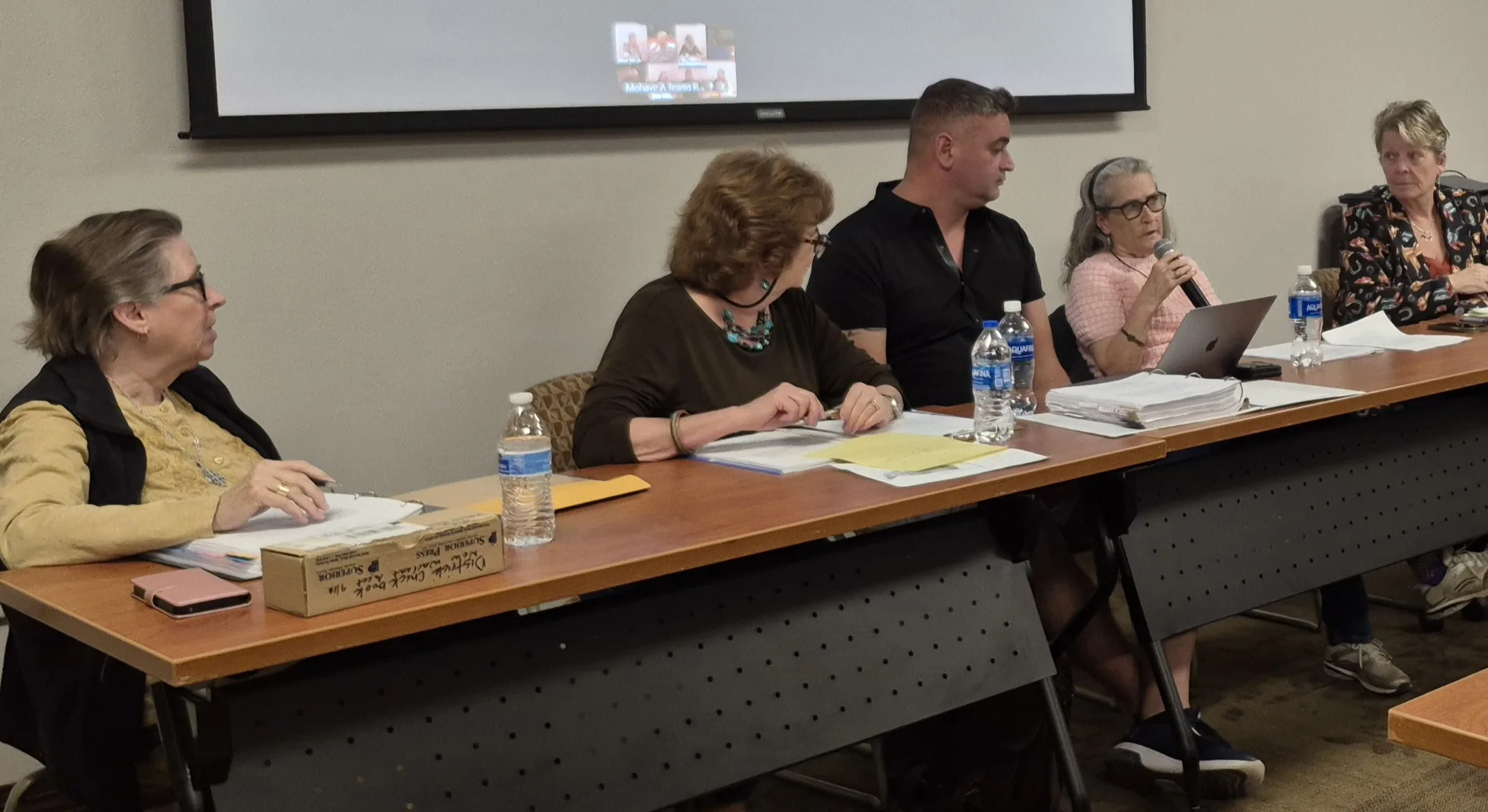
Board members discuss agenda items. L-R Chairman Katie Tacheron, Teresa Boegler, Logan Marsh, Dr. Carol Newmyer and Leanne Smith. Becky Foster
MOHAVE COUNTY — Hospital District Number One of Mohave County met on Tuesday with a list of agenda items which included a job description and pay range for a recording secretary; changes to how by-laws are structured; creation of a calendar with due dates; Arizona Open Meeting Law training; and a report on lease negotiations.
The new board members are enthusiastic and fully engaged. Senior member, Dr. Carol Newmyer, continues to be engrossed in the litany of issues the board is grappling with. She advised the board that she arranged for Mohave County Deputy Attorney Jason Mitchell to provide Arizona Open Meeting Law training on May 5 at 4:00 p.m. She added that will likely be the only agenda item.
Boegler and Smith provided reports and suggestions for the board utilizing their backgrounds in HR and real estate respectively. Logan Marsh, a local businessman, said he devotes time meeting with Mohave County officials and others; he said he spends many hours in the vault reading old minutes and documents in order to be up to speed in his job as a board member.
He is multi-tasking with the hospital lease, seeking quarters for a board office separate from KRMC and a possible intergovernmental agreement with Mohave County for various services. Chairman (Katie) Tacheron is working with Marsh on the hospital lease.
Boegler advised the board that her research revealed that the median pay for a recording secretary is $22.32 per hour (20 hours per month). She provided a job description for the position.
Currently, the recording secretary is provided by KRMC. The individual who was supposed to train with the current secretary declined the position. It is unclear whether the board will advertise to fill the position.
Upon inquiry of the board, the previous recording secretary, Catherine Furtado, was unpaid according to Cheryl Porter, KRMC CQO (Chief Quality Officer). Porter briefly served as the interim secretary after Furtado suddenly resigned without notice while publicly berating two board members. Of the two, Dr. Newmyer, remains on the board.
Due to an apparent public perception that KRMC and the District is one entity, the board is exploring setting up its own website, as well as hiring an administrator and a recording secretary in order to create distance between the two.
On July 28, 2022, a prior board unanimously voted to establish a website with a separate domain from KHI and set up official email addresses for the Board of Directors. Their attorney at the time recommended that they do so. However, that never came to fruition due to friction between board members.
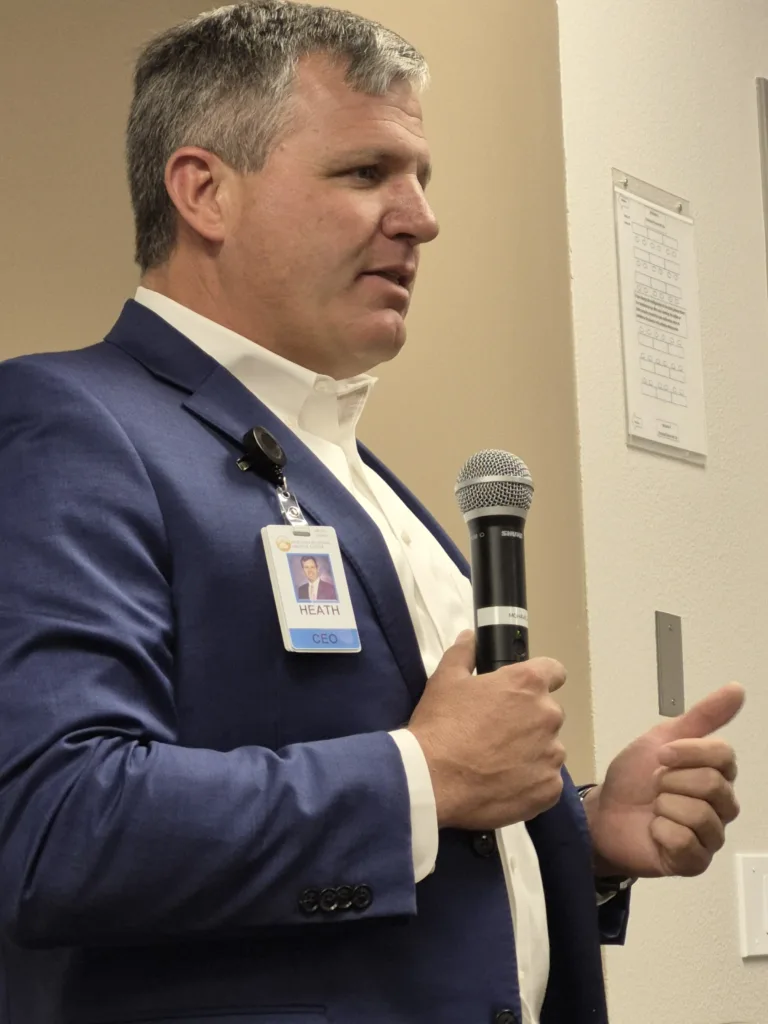
Heath Evans, President and CEO of KHI, thanked those that they (KRMC) met with about the lease. “We want to get a good, solid lease that matches today going forward,” he said.
He urged the board to consider the administrative position as a higher-level position than somebody taking notes or simply being an administrative assistant.
“You’re a multimillion-dollar business, and running once a month or once every two months for a board is not going to be highly productive,” he said.
During the discussions with hospital leadership, the board explored how federal funds are matched and returned to the institution. Federal rules require public entities to contribute money without any return to the public entity, but board members noted that the current implementation “does not operate as intended.”
Evans suggested separating the district’s lease payment from a new “community health investment” bucket. In this structure, lease payments would be paid for use of the hospital building, while a second pool would be available for the Board to invest in community health directives (i.e. GME, APSI and other potential agreements) at its discretion.
From 2011 to 2024 the hospital garnered more than $10 million (combined federal and local share) due to the GME intergovernmental agreement according to the official website for AHCCCs. According to a policy brief by the University of Arizona in 2023, a non-federal match is necessary to receive the GME funds. In 2023 the match was 75.76% federal and 24.24% local (statewide).
A total for funds related to the APSI agreement, which began in 2018, was not available at the time of this writing.
Becky Foster