






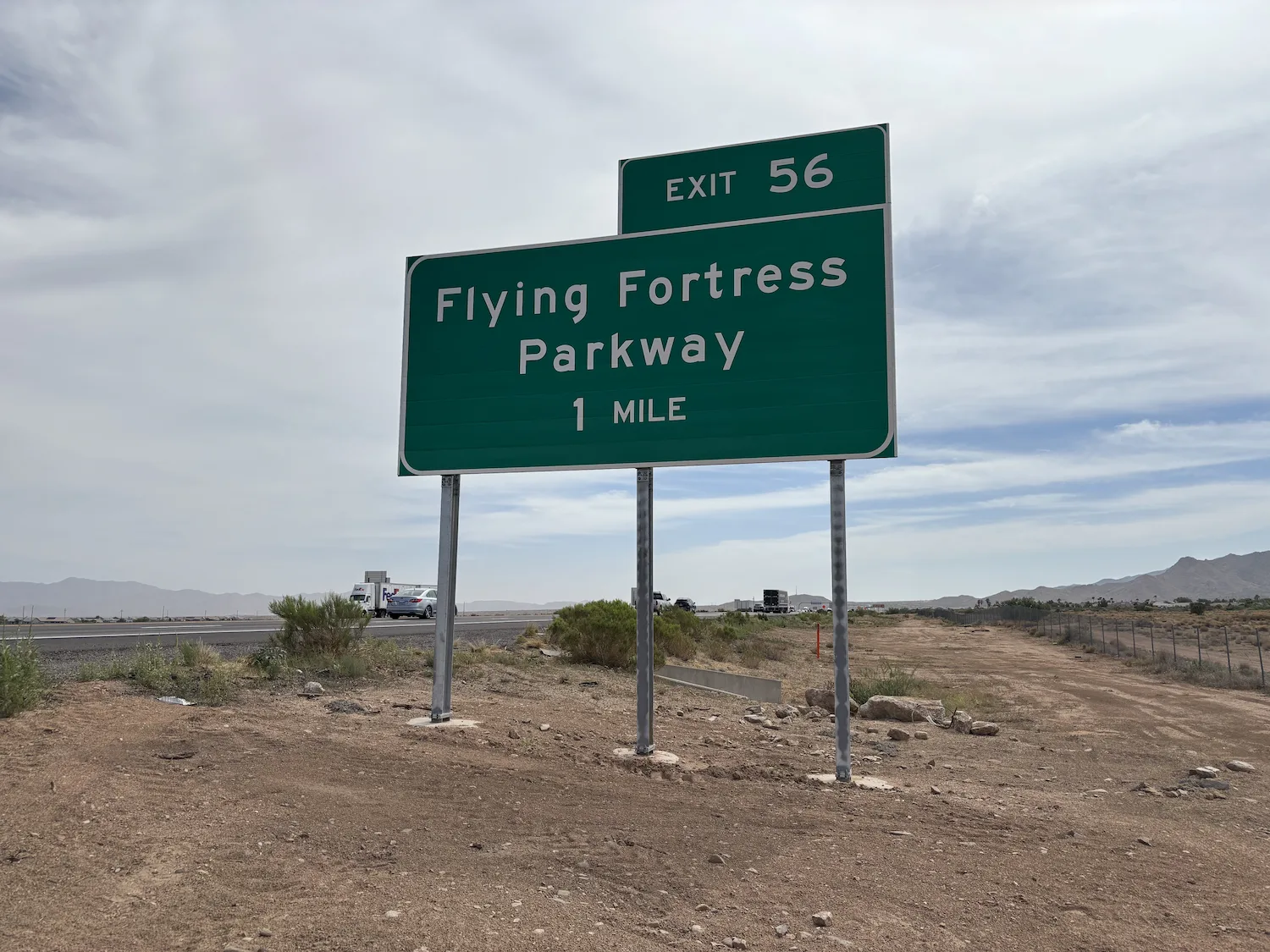
KINGMAN, Ariz. – The Interstate 40 Flying Fortress Traffic Interchange (TI) that begins carrying traffic following Monday’s ribbon cutting celebration is expected to be a game changer for Kingman community transportation and economic development.
Arizona State Transportation Board member and retired Mohave County Manager Sam Elters said he helped push the project when he served as ADOT’s District Engineer for northwest Arizona 2 decades ago.
“We saw a need to provide access off of I-40 to the airport, and in the process provide some relief to Andy Devine Avenue/Route 66,” Elters said. “The vision originally was to build a new traffic interchange east of Kingman that will connect to the airport industrial area and connect south to Hualapai Mountain Road.”
City Manager Tim Walsh said the remaining 2 miles of the Flying Fortress Parkway that will lead to the Kingman municipal airport should be completed by late next summer. He said bid award will occur in the weeks ahead with construction starting by early next year, if not sooner.
Local traffic patterns are expected to change once the motoring public adjusts to new travel options associated with the new Flying Fortress transportation infrastructure.
“We expect it will provide some relief to Hualapai Mountain Road,” Walsh said. “We do anticipate the intersection of Hualapai Mountain Road and Andy Devine will see some changes there.”
“Models are models and until people actually get out there, it’s hard to say exactly what is going to happen, but we do anticipate increased traffic on Louise Avenue. They’re going to hit Louise, get into the Hualapai foothills and Rancho Santa Fe,” Walsh said. “Tanner Schritter (developer) and that group working on their Hualapai’s Edge subdivision and the connector from Louise down to Southern – that will provide relief as well.”
Economic development activity is expected on both sides of I-40 near the new TI.
“The interest in Kingman because of this interchange has really piqued. We’ve talked to some major manufacturers that are looking at coming here that can provide a significant number of jobs,” Walsh said. “I think once those start coming it continues to stoke the flame of `hey, look at Kingman. They’ve got this now, why aren’t we there?’”
Schritter declined opportunity to provide an update of residential and commercial development planned along the south side of the interstate, though he shared some information when the City Council approved plan amendment and zoning requests in mid-May.
“We do not have any letters of intent right now, so we can’t tell you what it’s going to look like at this point,’’ Schritter said. “But, I do want to say that we are committed to doing something that’s great, something that has trees, something with greenery, something that looks nice, because I believe right now that’s what Kingman is lacking in the commercial world.”
Development Services Director Jason Moquin said several entities have made contact with city staff regarding potential development endeavors.
“However, only one project located north ofI-40 and west of Flying Fortress has submitted an application and that is for the re-plat and re-zone,” Moquin said, by email. He said a planned subdivision encompasses 184-acres extending north and west, from the northwest corner of Flying Fortress Parkway and I-40 to Diamond Joe.
Director Bennett Bratley said the City’s economic development team is excited about new activity and growth potential.
“We expect a mixture of development on both sides of Interstate 40. South of I-40, we anticipate substantial residential growth supported by neighborhood retail, services and other compatible uses. Near the interchange, commercial development will likely occur on both sides due to visibility and interstate access,” Bratley said. “North of I-40, the corridor becomes increasingly focused on employment-generating uses as it approaches the existing Airport and Industrial Park and the future Phase II expansion.”
Bratley views the Flying Fortress TI as a new gateway to eastern Kingman.
“Our long-term vision is a coordinated employment and mixed-use corridor where industrial development, housing, commercial services, workforce training and transportation infrastructure grow together,” Bratley said.