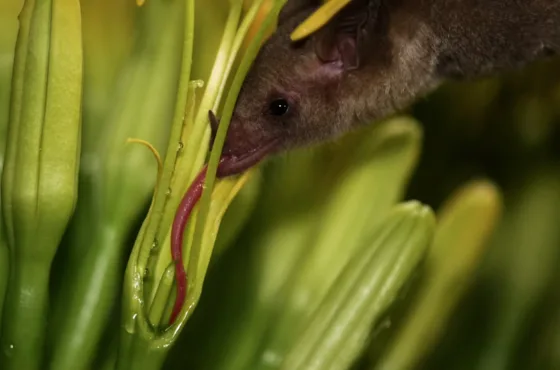






PORTAL, Ariz. – The Arizona Game and Fish Department (AZGFD) is excited to share that the U.S. Fish and Wildlife Service (USFWS) and Bat Conservation International (BCI) have announced the confirmation of Mexican long-nosed bats (Leptonycteris nivalis) in southeastern Arizona. The Mexican long-nosed bat, which is now Arizona’s only bat listed as endangered under the Endangered Species Act, brings the total number of bat species in our state to 29.
“Knowing for sure is exciting,” said Angie McIntire, AZGFD’s statewide bat specialist. “It’s a species that we thought probably occurred in Arizona, but the scientific breakthroughs that enabled the confirmation of its presence are the real highlight of this story.”
Traditionally, biologists would have to catch a bat and have it in hand to identify it. This study, which utilized citizen science and environmental DNA (eDNA), revolutionized the way scientists can learn about animals, their location, and their movement.
Residents in southeastern Arizona and southwestern New Mexico collected eDNA by swabbing hummingbird feeders for trace amounts of saliva left by bats in the area. The samples were then sent to the “Species from Feces” lab at Northern Arizona University that specializes in utilizing non-invasive environmental clues to identify species.
“If we were trying to identify the species in the absence of eDNA, biologists could spend hours and hours trying to catch one of these bats, and even then, you’re not guaranteed to be successful,” said McIntire. “By sampling the environment, eDNA gives us an additional tool for our toolkit, allowing researchers to confirm the presence of this rare species without actually having to catch one in the wild, which can be very difficult.”
Adding to the difficulty of identifying the Mexican long-nosed bat is the fact that it’s nearly indistinguishable from its “sister species,” the recently delisted lesser long-nosed bat (Leptonycteris yerbabuenae). There are some subtle differences between the two — for example, the Mexican long-nosed bat is slightly larger and prefers somewhat higher elevations in pine-oak habitats — but eDNA makes differentiating them easy.
The appearance of this species at hummingbird feeders in southeastern Arizona is a reminder that some bat species can fly great distances at night to find food, and this could possibly indicate an undiscovered roost in the vicinity. The Mexican long-nosed bat primarily feeds on nectar or pollen from at least 49 different species of flowering plants across their range, and many species of Agave in the US.
Meet Arizona’s new bat species